Give the idea a foundation
Explore your premise, themes, characters, and setting. Find what your story is really about before the blank page asks everything of you.
FOR THE BOOK YOU KEEP THINKING ABOUT
You don’t need to know how to write a whole book today. Start with an idea. Shape your story, meet your characters, and find your next chapter.
Writing first. AI tools when you want them.
Catch the idea
A keeper returns to Bellwether to close her father's lighthouse. Inside the lens, she finds a tide table with one night missing.
A LITTLE LESS “WHERE DO I START?”
From the first question to the last chapter, keep the pieces of your book connected. Build confidence by making one manageable decision at a time.
Explore your premise, themes, characters, and setting. Find what your story is really about before the blank page asks everything of you.
Shape an outline. Give each chapter a purpose and a sequence of beats. See the next step without holding the whole book in your head.
Move between your chapter plan and prose, keep versions as your ideas change, and read your accepted chapters together as a manuscript.
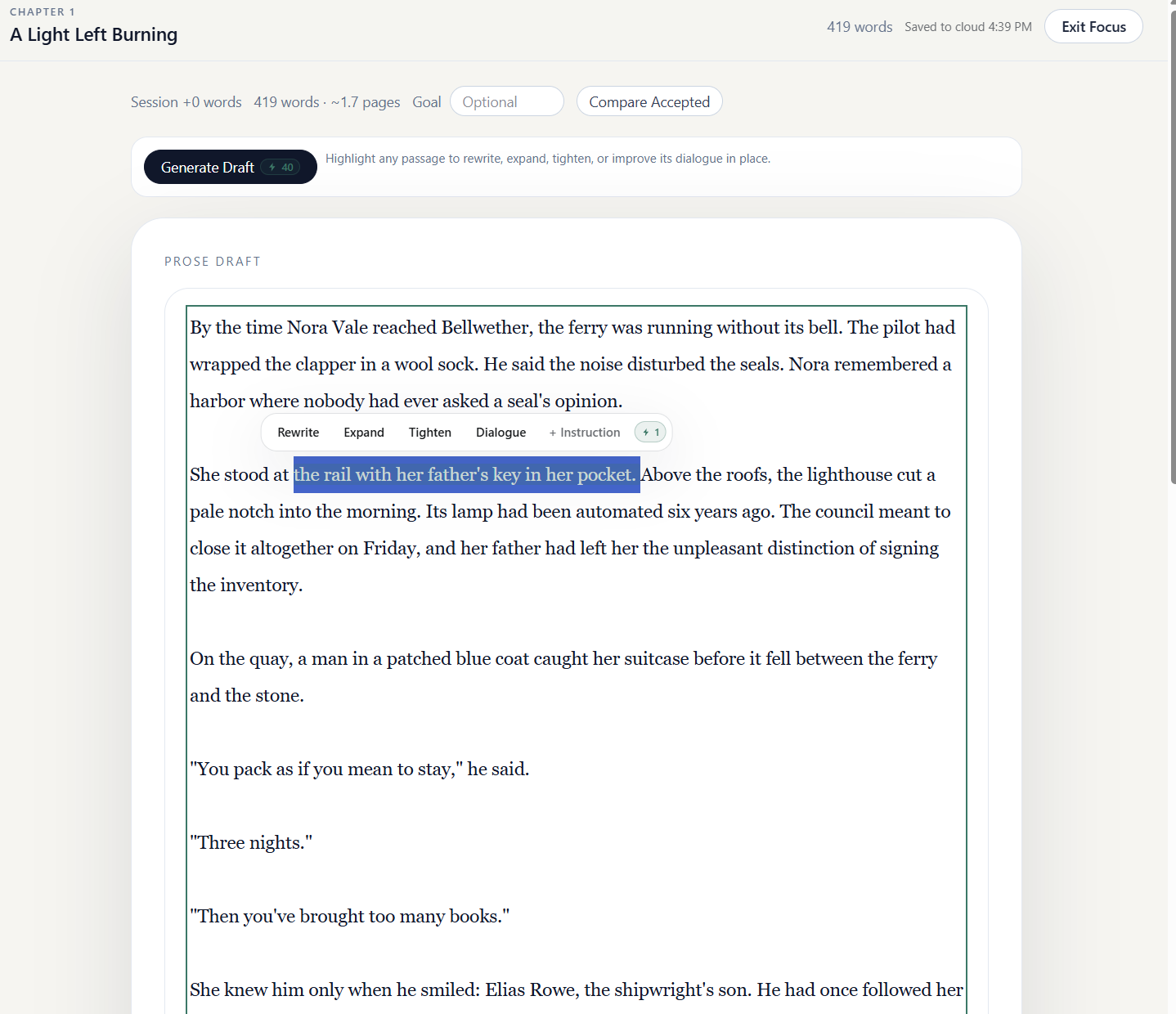
More of a discovery writer? Capture what you know, write to find out more, and return to your plan as the story changes.
SAME STORY. YOUR KIND OF SPACE.
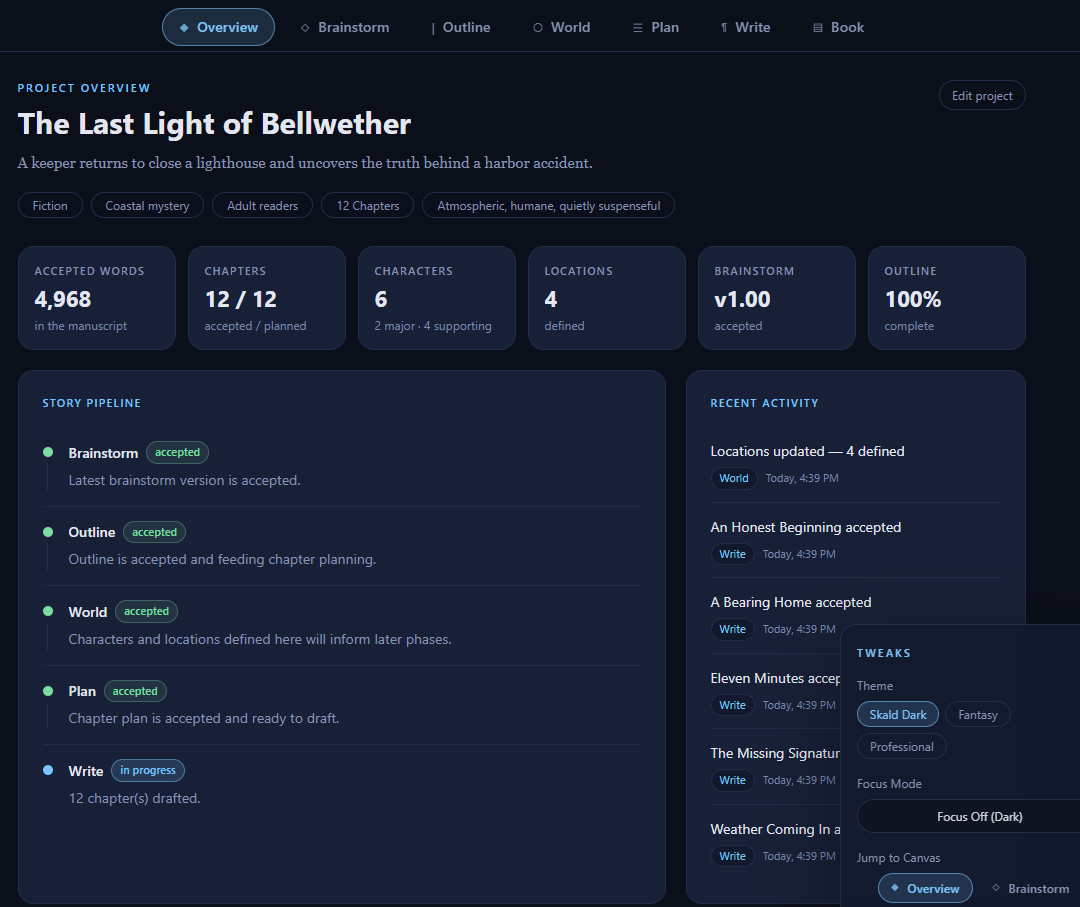
Three themes, each with a dark view and a light Focus Mode. Find the colors you want around you as your book takes shape.
A different atmosphere.
The same place for your story.
FROM A NAME ON THE PAGE TO SOMEONE YOU CAN SEE
A goal. A contradiction. A secret. Build characters with something at stake, then use portrait generation to explore how you picture them.
 CHARACTER / 01
The keeper
She can read a storm before it arrives. Her own family is harder to understand.
 CHARACTER / 02
The shipwright
Good with broken things. Less certain how to repair the truth.
 CHARACTER / 03
The archivist
She remembers what the harbor would rather forget.
02 — SEE WHAT CHANGES BETWEEN THEM
Who trusts whom? What changed after that chapter? Map the connections between your characters, record the moments that shift them, and move through your story’s relationship timeline.
A useful way to see your story’s emotional structure alongside its plot.
Relationship mapping is included on every plan Nora ValeThe keeper
 Elias RoweThe shipwright
 Mara · sister
Nora needs Elias's boat. She doesn't yet trust the man steering it.
GIVE YOUR STORY A SENSE OF PLACE
The lighthouse stair. The tide beneath the quay. The room where a promise was broken. Keep locations and world details close to your characters and chapters.
BELLWETHER / LOCATION NOTE
Structure · Coastal headlandA stubborn door, a brass lens, and eleven missing minutes.
The keeper’s house and lantern room overlook the harbor’s eastern entrance.
Nora returns to close it. The story gives her a reason to stay.

 Nora Vale · Elias Rowe
Why would Nora trust Elias again? I want it to feel earned.
Let him tell the truth before he knows it will help him. What could admitting his part cost him?
He gives her the signed ledger, knowing she can take it to the harbor council.
03 — A CREATIVE CONVERSATION, WHEN YOU NEED ONE
Talk through a character’s motivation. Explore a scene that isn’t quite working. Ask Agent Skald for another angle using the story context available in your workspace.
Keep what helps. Leave what doesn’t. Planning, writing, editing, and exporting are yours to use without spending AI credits.
How optional tool credits workBEFORE YOUR FIRST CHAPTER
Yes. The workflow breaks a large project into smaller decisions: an idea, an outline, characters and world details, a chapter plan, and the writing itself. You can build your understanding as you work. Skald is a writing workspace, not a promise that a first draft will write itself.
Yes. You can develop your ideas, create your outline and cast, map relationships, plan chapters, write, edit, and export without using AI tools. Manual work doesn’t use AI credits.
Only when you choose a tool that generates text. You can use Agent Skald simply to discuss an idea, use portraits to picture your cast, or work without AI. Your decisions shape the book.
Export your accepted manuscript chapters as Word (DOCX), PDF, or Markdown. These formats are available on every plan.
THE BOOK WON’T BEGIN WITH EVERYTHING FIGURED OUT.
Start free. Bring your own words. See where they take you.